
7 Wonders of India: 7 Magnificent Historical Monuments You Must Explore
Are you someone who is tired of limiting India’s architectural grandeur to the Taj Mahal alone? Want to explore more? Or perhaps admire the beauty of some of the finest creations of Indian artisans? The construction of the Taj Mahal is undoubtedly aesthetically pleasing, but India is home to many other architectural wonders known for their beauty and intricate detailing.
While opinions may differ from person to person, Itihaas ki Khoj presents its own version of The 7 Wonders of India.
India’s 7 Greatest Historical Wonders: A Journey Through Ancient Architecture
Are you someone who is tired of limiting India’s architectural grandeur to the Taj Mahal alone? Want to explore more? Or perhaps admire the beauty of some of the finest creations of Indian artisans? The construction of the Taj Mahal is undoubtedly aesthetically pleasing, but India is home to many other architectural wonders known for their beauty and intricate detailing.
While opinions may differ from person to person, Itihaas ki Khoj presents its own version of The 7 Wonders of India.
1. SANCHI STUPA

Located in the town of Sanchi in Madhya Pradesh, the magnificent stone-built dome is famously known as the Sanchi Stupa. Commissioned by the Mauryan Emperor Ashoka, this iconic structure was originally constructed in the 3rd century BCE, following his conversion to Buddhism.
A marvel of Buddhist art and architecture, the Sanchi Stupa houses relics associated with Buddha and serves as an important symbol of Buddhist heritage.
I have always thought that it bears a resemblance to the Gol Ghar in Patna, Bihar, although Gol Ghar was built as a granary.
The gateways are among the most remarkable and distinctive features of the Sanchi Stupa. There are four beautifully carved gateways, each approximately 10 metres high and 7 metres wide, featuring intricate carvings depicting the teachings and life of Buddha. These gateways are considered masterpieces of ancient Indian architecture and have influenced generations of artists and architectural traditions.
A symbol of faith, art, and culture, the Sanchi Stupa has become a significant pilgrimage site, attracting Buddhist followers from far and wide.
On our list of the 7 Wonders of India, we place the Sanchi Stupa at 7th position.
2. HAMPI
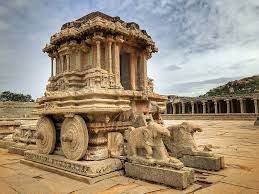
The name Hampi is derived from Pampa, an ancient name associated with the River Tungabhadra. Pampa was also the name of a goddess associated with Lord Brahma. According to mythology, she was a devotee of Lord Shiva. Pleased with her devotion and penance, Lord Shiva granted her a boon, and she asked him to marry her. Therefore, Shiva is also known as Pampapati. It is believed that Hemakuta Hill is where Parvati performed her penance.
Hampi predates the Vijayanagara Empire, and its mythology is also associated with the Ramayana. According to popular belief, the Vanara Sena of Lord Rama in the Ramayana belonged to this region.
Today, the monuments of Hampi form part of a UNESCO World Heritage Site and represent the magnificent remains of the Vijayanagara Empire.
Most of the monuments are Hindu in origin, with temples and public infrastructure, including water tanks and marketplaces, reflecting Hindu deities, traditions, and religious texts. The region also has Jain temples and a mosque, reflecting the diverse religious influences that shaped its history.
The architectural style of Hampi is predominantly Dravidian.
We place this magnificent historical destination at 6th position on our list.
3. CHARMINAR

The 16th century in Hyderabad witnessed a devastating plague. This magnificent monument emerged as a result of prayers offered for the plague to end. Built by Muhammad Quli Qutb Shah, the fifth Sultan of the Qutb Shahi dynasty and the founder of Hyderabad, Charminar was constructed after he vowed to build a magnificent structure if his prayers were answered and the plague came to an end.
Today, Charminar is an integral part of Hyderabad’s identity. It has witnessed countless historical events, processions, celebrations, and cultural gatherings.
As its name suggests, the monument features four towering minarets.
The combination of white marble and black granite creates a striking visual contrast, making the structure even more appealing. Surrounded by bustling local markets, Charminar looks particularly captivating during sunset and at night when it is beautifully illuminated.
This architectural masterpiece reflects a blend of Indian, Islamic, and Persian influences, showcasing the cultural diversity of the region and earning the 5th position on our list.
4. GOLDEN TEMPLE

Situated in the city of Amritsar, also known as the ‘City of the Guru’, this place of worship is truly a golden treasure among Indian monuments, both metaphorically and literally.
The Golden Temple, also known as Harmandir Sahib, is one of the holiest sites for Sikh devotees.
The foundation of the sacred town was laid under the guidance of Guru Ram Das, the fourth Sikh Guru, following the vision of Guru Amar Das, the third Guru. The vision was to create a place where people of all castes, creeds, and religions could come together and live in harmony. This vision led to the development of the sacred pool known as Amrit Sarovar, meaning the ‘Pool of Nectar’.
The fifth Sikh Guru, Guru Arjan Dev, commissioned the construction of Harmandir Sahib in the middle of the sacred pool. The temple has witnessed several attacks and periods of destruction but has been restored each time.
In the 19th century, Maharaja Ranjit Singh contributed to the temple’s restoration and beautification. In 1830, the temple was adorned with marble and copper, and its upper structure was covered with gold, giving it the name by which it is popularly known today.
The water of the sacred pool reflects the image of the temple, creating a mesmerising and almost symmetrical view.
A monument of exquisite beauty and an even more beautiful purpose, the Golden Temple stands as a symbol of humanity, equality, and unity.
It earns the 4th position on our list.
5. CHAND BAORI

It is believed that Raja Chanda, a local ruler of Rajasthan, built this magnificent stepwell to address the problem of water scarcity in the region.
One of the most fascinating facts about Chand Baori is its extraordinary architectural design, which makes it one of the most remarkable stepwells in India.
One of the most picturesque stepwells in the country, Chand Baori features approximately 3,500 steps arranged across 13 levels, leading down to the water at the bottom of the well. The resulting geometric pattern offers an astonishing visual experience.
Three sides of the stepwell consist of a symmetrical series of steps, while the fourth side features multi-storeyed structures that include rooms and spaces associated with the royal family and religious activities.
The ruler had great faith in Harshat Mata, the Goddess of Joy and Happiness. Therefore, a temple dedicated to the goddess was built nearby, which became an important pilgrimage site for devotees.
While pilgrims visited the temple to seek blessings, they could also quench their thirst and rest in the surrounding spaces.
Over the centuries, the temple and its surroundings underwent damage and destruction, leaving behind traces of their glorious past.
This highly geometric and architecturally remarkable stepwell secures the 3rd position in our quest to discover the 7 Wonders of India, owing to its extraordinary symmetry and design.
6. MEENAKSHI TEMPLE

According to mythology, the goddess worshipped here emerged from the sacred fire of a Yajna, already three years old and with three breasts.
The royal couple, King Malayadhwaja Pandya and his wife Kanchanamalai, were concerned about their daughter’s unusual physical appearance. However, a divine voice reassured them that they need not worry, as her third breast would disappear when she met her destined husband.
The couple named her Meenakshi and eventually crowned her as their successor.
It is believed that Meenakshi was an incarnation of Goddess Parvati. When she encountered Lord Shiva, worshipped here as Sundareshwara, her third breast disappeared, confirming that he was her destined husband.
Situated in the heart of Madurai, the Meenakshi Amman Temple is considered to be as old as the city itself.
The most striking features of this temple are its magnificent Gopurams, which are richly decorated with vibrant and colourful sculptures. These intricate carvings depict various Hindu deities, mythological creatures, and celestial beings, symbolising the heavenly abode of the gods.
The temple’s overall colour scheme is designed to be visually striking, drawing the attention of visitors from afar. The combination of vibrant colours and intricate sculptures makes the temple a breathtaking architectural masterpiece.
The magnificent Meenakshi Temple earns the 2nd position on our list.
7. AJANTA AND ELLORA CAVES
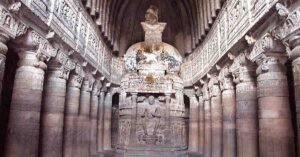
A group of 29 caves arranged in a horseshoe-shaped formation, the Ajanta Caves date back to the 2nd century BCE through the 6th century CE. In contrast, the Ellora Caves form a linear cluster of rock-cut monuments dating from the 5th to the 10th century CE.
The Ajanta Caves are renowned for their vivid paintings and sculptures depicting Buddhist stories, while Ellora is celebrated for its monumental rock-cut architecture and diverse religious representations.
These caves showcase exceptional examples of rock-cut architecture, sculpture, and painting while providing valuable insights into India’s rich cultural and religious history.
While the Ajanta Caves primarily depict the life of Buddha and various Jataka tales, the Ellora Caves feature Buddhist, Hindu, and Jain monuments, representing the coexistence of different religious traditions.
Fact: The Ellora Caves are featured on the reverse side of the Indian ₹20 currency note.
The beauty of these caves is undeniable and exceptional. Their historical significance, artistic brilliance, and architectural grandeur earn them the 1st position on our list.
CONCLUSION
This was our version of The 7 Wonders of India.
While some people may agree with our choices, others may have a different opinion. However, one cannot deny the beauty, historical significance, and aura of these magnificent monuments.
Let us know in the comments section if we missed any architectural wonders that deserve a place on this list.
Until then, keep exploring India’s glorious past with Itihaas ki Khoj. We will see you in the next blog!